
Interview: Real Productivity Instead of Mere Duty Fulfillment

Updated: Feb 17

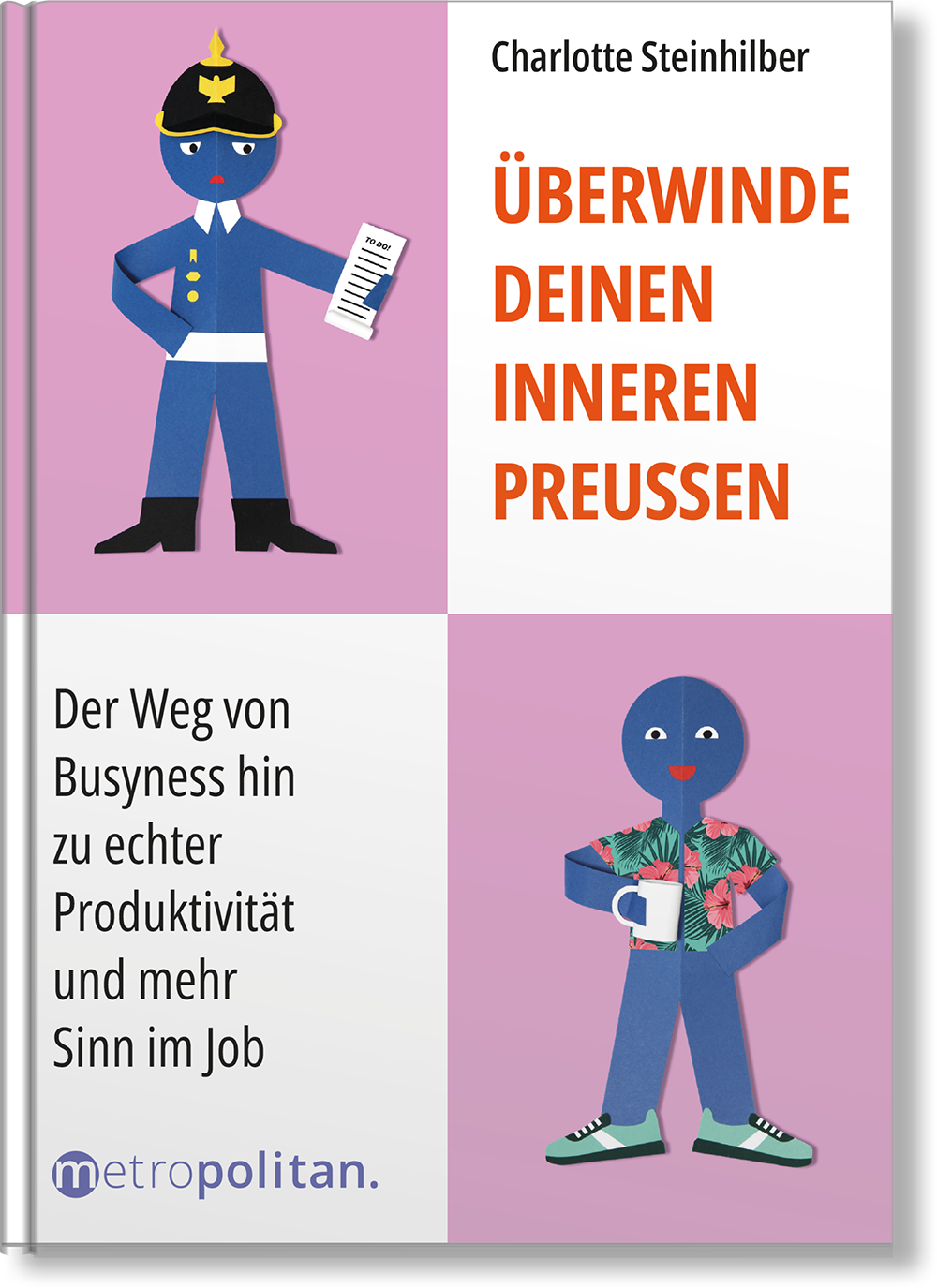
Charlotte Steinhilber is a business psychologist and works in leadership development at the well known German industrial and technology group thyssenkrupp, as well as independently as a leadership coach. At the end of 2025, she published the book “Overcome Your Inner Prussian. The Path from Busyness to Real Productivity and More Purpose at Work”, in which she shows how discipline, when no longer an end in itself, can be transformed into value-creating and meaningful work. Interviewed by MindPlayfield co-author Bei Bei Yu.
Bei Bei: Charlotte, the title of your book, “Overcome Your Inner Prussian,” immediately caught my attention. What motivated you to write this particular book?
Charlotte: The idea has accompanied me for many years. My book is primarily aimed at today’s knowledge workers. I want to make our often outdated understanding of work visible. We live in a time of rapid change: geopolitical uncertainty, artificial intelligence, and more. This calls for a modern understanding of productivity—beyond diligence and endurance at any cost. My goal is to provide impulses for how we can create sustainable value through our work, in today’s world.
Bei Bei: Why did you choose the “inner Prussian” as a metaphor for our work mentality?
Charlotte: Especially in German-speaking culture, the Prussian character stands for virtues such as discipline and perseverance. These virtues certainly have their strengths. But many people live them today to an unhealthy extent. Highly committed individuals often tell themselves: “Work first, pleasure later; Only high performance makes me valuable. ” I see these patterns frequently in my coaching sessions. With the “inner Prussian,” I wanted to make this mindset visible and tangible. In the book, I offer suggestions on how to find a healthy balance.
Bei Bei: You distinguish between busyness and productivity. What is the difference, and how can I tell whether I’m busy or productive?
Charlotte: Being busy has meanwhile become a status symbol (similar to having a corner office in the past): full calendars, countless meetings, and long to-do lists leave little time to breathe and create constant stress. But for us knowledge workers, who are paid to think, this is not a sustainable mode.
For me, productivity means truly examining where the impact of one’s own work—or that of the team—lies: Where do I make the greatest possible contribution to the company’s value creation?
So-called “fake work,” for example, describes activities that merely create the impression of being busy and are intended to advance one’s career, rather than delivering real value. Genuine productivity, on the other hand, is consistently results-oriented and contributes to the company’s future success.
Bei Bei: Does this apply equally to employees and leaders?
Charlotte: Yes, absolutely. The question of one’s own value contribution is crucial for all of us in the modern working world. In addition to their own productivity, leaders are responsible for creating conditions that enable productivity. They achieve this by designing structures and setting priorities.
Bei Bei: What methods do you use as a leadership coach to help your clients achieve real productivity?
Charlotte: I work on three levels:
Toolset: How do we reduce distractions? How do we design calendars, focus times, and meeting-free spaces? Studies show that, on average, we are interrupted every two minutes. That costs enormous amounts of energy.
Skillset: Prioritizing, delegating, setting boundaries—classic but crucial skills.
Mindset: Here I use the method of the inner team, which I describe in detail in the book. It makes visible which inner parts are loud, which have been neglected, and which strengths lie hidden within us. This is an important lever for developing potential.
Bei Bei: Could you briefly explain the concept of the inner team for our readers?
Charlotte: The method comes from the renowned communication psychologist Friedemann Schulz von Thun. It describes that we don’t just have one inner “self,” but many inner parts. Some are loud, some quiet, and some even contradict one another.
This diversity is nothing new. Even Bismarck referred to it when he said: “Faust complains about the two souls in his breast, but I harbor a whole multitude that quarrel with each other. It’s like a republic in there…” The first step is to make these parts visible—for example, on a flipchart—and then to give them names. This helps us recognize patterns: Which voice dominates? And why is it so loud?
Sometimes people feel at the mercy of their inner team, but in the book I show that we are the “leader” of our inner team. This is core of self-leadership. We can’t fire any parts, but we can further develop them and learn to view them with more kindness and curiosity. We should lead our inner team in a way that supports us in achieving our goals.
Bei Bei: I can only confirm your perspective. After having good experiences with this methodology myself, I often use it in my coaching with clients.
Charlotte: I hear that often. The method is both accessible and profound.
Bei Bei: For you, real productivity is also linked to “purpose.” What does purpose personally mean to you?
Charlotte: Purpose is, of course, a big word. For me, purpose arises when we can contribute our strengths, take responsibility, and feel: “What I do matters.”
The Harvard Study of Adult Development on life satisfaction is particularly interesting here. It shows that good relationships and a sense of belonging have the strongest impact on our happiness. This also applies to work. An appreciative, trust-based work environment strongly contributes to us experiencing our work as meaningful and increases our satisfaction.
Bei Bei: Purpose is often associated with younger generations, while Prussian virtues are attributed to older ones. Does this generational difference actually exist?
Charlotte: Current research doesn’t really support that. There is a lot of discussion about it, and certainly there are certain trends among younger generations. But I’ve also coached people under 30 who struggled greatly with their inner Prussian. I also see hardly any generational differences when it comes to purpose and belonging—at least not statistically. After all, everyone needs these things. Perhaps younger generations are quicker to seek change when they don’t experience purpose or when a job doesn’t fit their personality.
Bei Bei: That’s something the older generation could also learn from the younger ones.
Charlotte: Yes, absolutely. There is great potential for mutual enrichment. And my book is not an appeal along the lines of “leisure first and work is unnecessary.” Instead, I believe that work can be energizing and fulfilling when we contribute and help shape things. The question is how we achieve something together.
Bei Bei: Let’s imagine, in the future we’ve all overcome our inner Prussian. What will our world look like in 20 years?
Charlotte: I imagine it to be very beautiful, because our societal work mentality would then be far more effective and allow us to show up at work as whole human beings. While today we often put on a “mask” for self-protection, we could then take it off—thanks to a sense of psychological safety. What does psychological safety mean?
You can address problems openly.
You can say when you’re not doing well.
You can deal with conflicts openly and work through them without fear.
And psychological safety is precisely the factor that, according to scientific findings, contributes most strongly to high-performing teams. High-performance is a shared goal for many high achievers and people who enjoy performing: it is crucial for our present and the future economy in Germany and Europe.
Bei Bei: This means interacting at eye level, regardless of hierarchy—a wonderful vision for the future. Is there one more aspect from your book that you’d like to share with our readers?
Charlotte: In the book, I address six different individual risks that arise when we let ourselves be governed by the inner Prussian. They are meant to raise awareness of what certain thought and behavior patterns can cost us. Beyond that, leaders should also look at economic risks, such as limited creativity and innovation.
Another important aspect is the counter-question: Can we create work systems and cultures that don’t further fuel Prussian virtues? Can we develop a healthy focus on results? How do we concentrate on what is effective for each individual team?
Other than that, I warmly invite everyone to read the book themselves.
Bei Bei: One last question, what did your writing do to your own inner Prussian?
Charlotte: I know my inner Prussian from my own personal development work, and I’ve changed it a lot—through career decisions and through balancing professional and family life. Today, I experience my inner Prussian as an inner “doer” who has evolved. She stands for high energy, creativity, and above all, drive. She helped me complete this book project.
I use this “doer mode” for goals and topics that are close to my heart as the leader of my inner team and that I want to stand up for. For that, my inner doer is very helpful. Now, she also enjoys times when she can lean back and isn’t needed. Then other of my innter team members are allowed to step up. That’s a wonderful development—for me personally as well.
Bei Bei: Thank you very much for these personal insights and for the inspiring conversation.
You find Charlotte's book here:
If you are interested in her coaching offering, please visit her website:

